Learner:
Grade & Section:
Date:
Score:
MATATAG Competency
Describe the position and movement of an object relative to a reference point, and measure distance using standard metric units.
Key Scientific Concepts:
• Reference Point: A fixed place or object used to determine whether another object is in motion.
• Distance: The total length of space traveled between two positions. Standard metric units: millimeter (mm), centimeter (cm), meter (m), and kilometer (km).
Part A
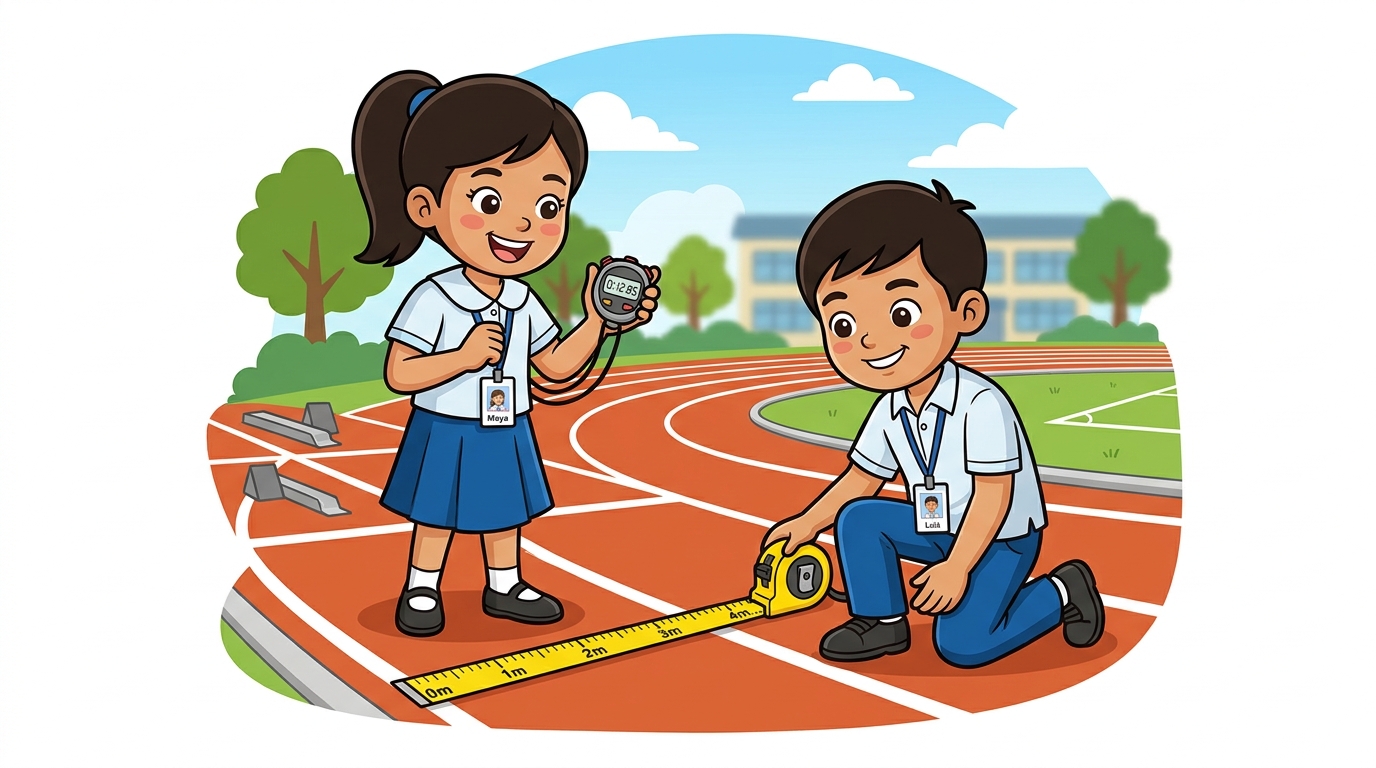
Observation & Reference Points: Analyze Maya and Leo on the track above. Answer each question clearly.
1. Leo rolls out a tape measure starting from the white start line toward Maya. What serves as Leo's reference point to prove he moved forward?
2. Leo measures 4 meters along the lane. Why is the meter (m) a more practical unit for measuring a running track than centimeters (cm)?
3. Maya stands still at the finish line holding the stopwatch. Relative to the ground and finish line, is Maya moving? Explain why.
4. Complete the metric distance conversion: 1 meter (m) = ______ centimeters (cm) and 1 kilometer (km) = ______ meters (m).
Learner:
Grade & Section:
Date:
Score:
MATATAG Competency
Identify and use standard measuring tools (rulers, tape measures, stopwatches, timers) to measure distance and elapsed time.
Standard Measuring Instruments:
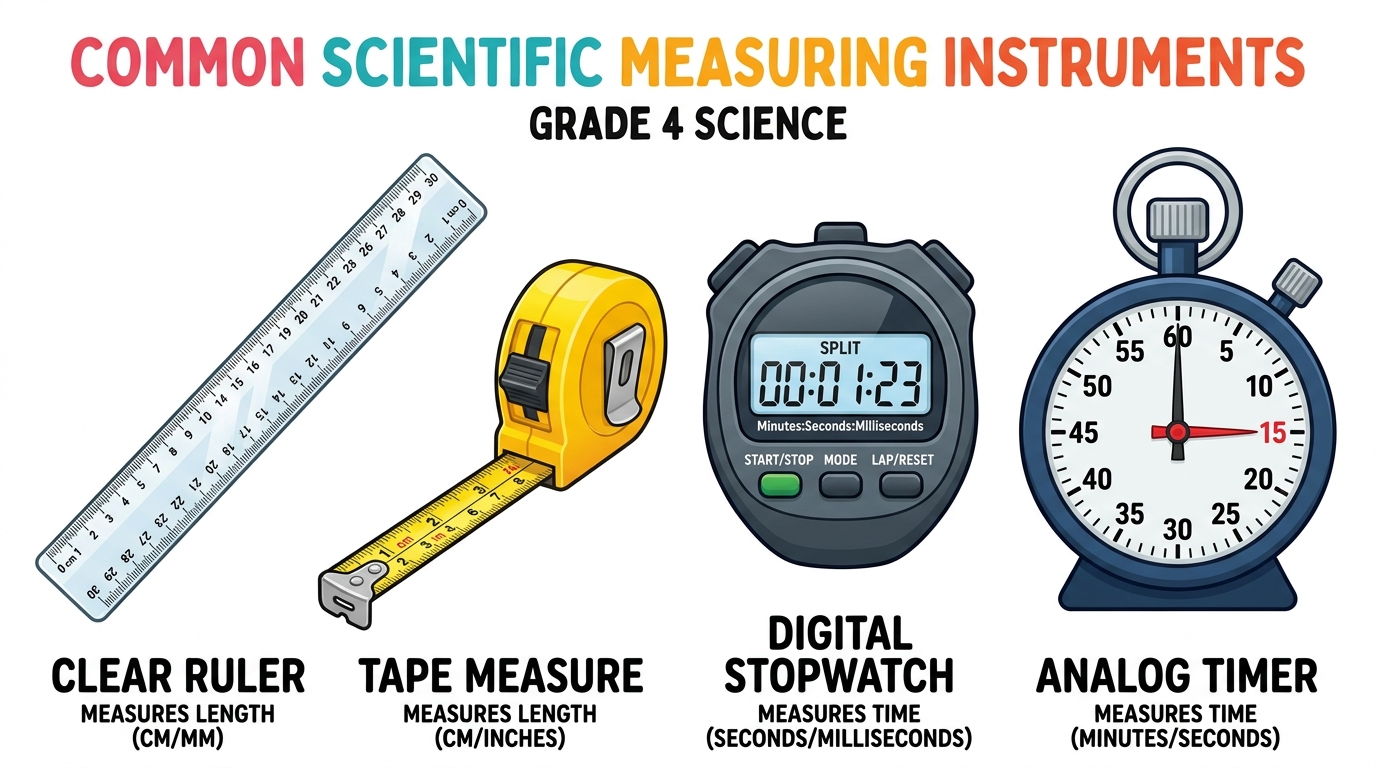
• Distance Tools: Ruler (short objects in cm/mm), Tape Measure (longer distances, curves in m/cm).
• Time Tools: Stopwatch (split seconds & seconds for fast motion), Analog/Digital Timer (minutes & hours). 1 minute = 60 seconds.
Part B
Tool Matching: Choose the best measuring tool for each scientific scenario.
| Scenario |
Best Scientific Instrument |
| 1. Measuring the length of a Science textbook in class |
[ ] Ruler [ ] Stopwatch |
| 2. Timing how long it takes a marble to roll across the floor |
[ ] Tape Measure [ ] Digital Stopwatch |
| 3. Measuring the distance of a 50-meter sports track |
[ ] Tape Measure [ ] 30-cm Ruler |
Part C
Paligsahan sa Barangay 60m Dash: Examine the race data table and answer the questions.
| Student Runner |
Distance Run |
Time Recorded |
Finishing Rank |
| Danica |
60 meters |
10 seconds |
________________ |
| Jasmine |
60 meters |
11 seconds |
________________ |
| Mateo |
60 meters |
12 seconds |
________________ |
| Rafael |
60 meters |
15 seconds |
________________ |
1. Who is the fastest runner, and how does their recorded time prove this?
2. How many seconds faster was Danica compared to Rafael?
Learner:
Grade & Section:
Date:
Score:
MATATAG Competency
Relate distance traveled and time taken to describe speed (fast or slow motion) in everyday Philippine situations.
Concept
Speed Formula: Speed = Distance ÷ Time. (Unit: meters per second or m/s).
Part D
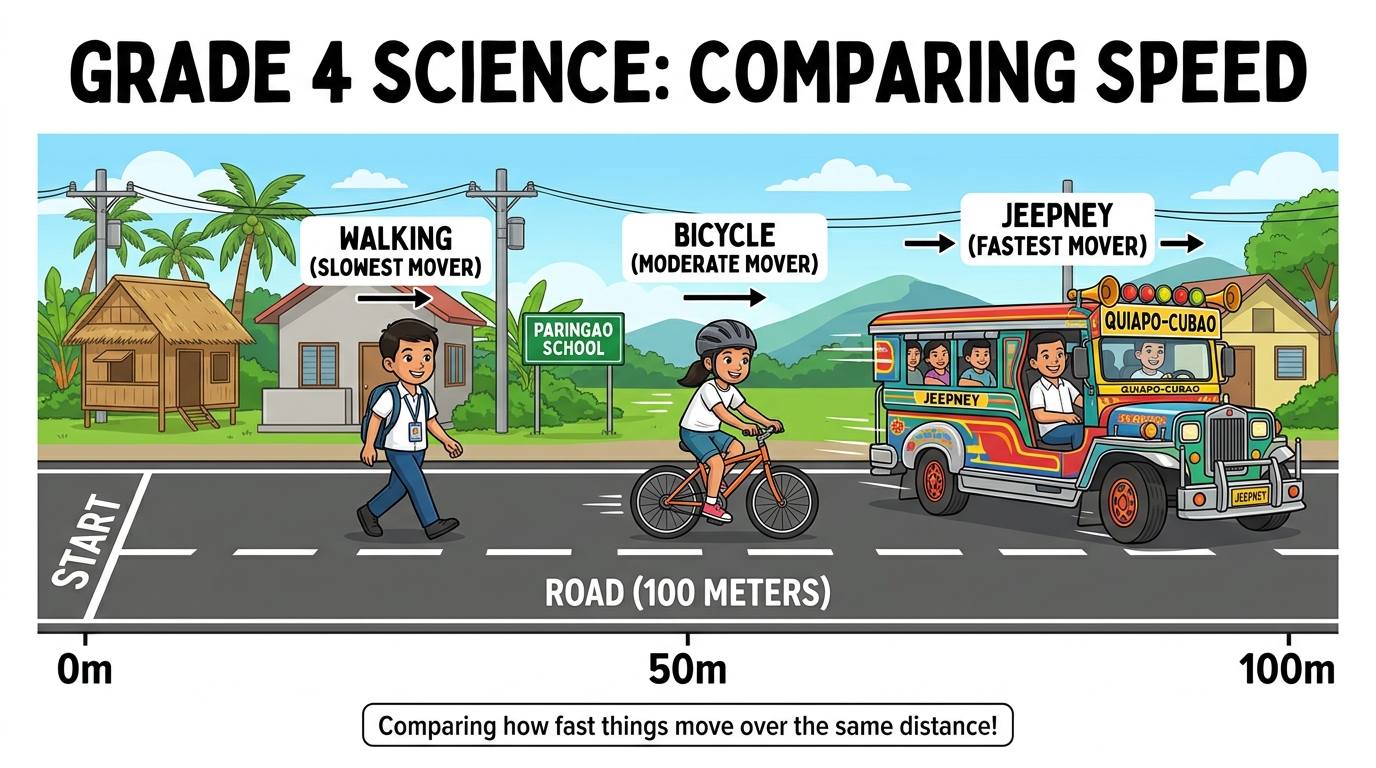
Community Motion Investigation: All three movers traveled a distance of 100 meters along the road.
| Mover |
Distance |
Time Taken |
Calculation (Distance ÷ Time) |
Speed |
| Student Walking |
100 meters |
50 seconds |
100 m ÷ 50 s |
2 m/s |
| Bicycle |
100 meters |
20 seconds |
100 m ÷ 20 s |
5 m/s |
| Jeepney |
100 meters |
10 seconds |
100 m ÷ 10 s |
10 m/s |
1. When distance is the same (100 meters), does a faster object take more time or less time? Explain why.
2. How many meters will the bicycle travel if it keeps riding at 5 m/s for 6 seconds?
3. Why must vehicles like jeepneys slow down to a lower speed when passing by a school zone?
Learner:
Grade & Section:
Date:
Score:
MATATAG Inquiry
Conduct guided scientific investigations on motion; collect distance and time data; and apply findings to safety.
Inquiry Investigation:
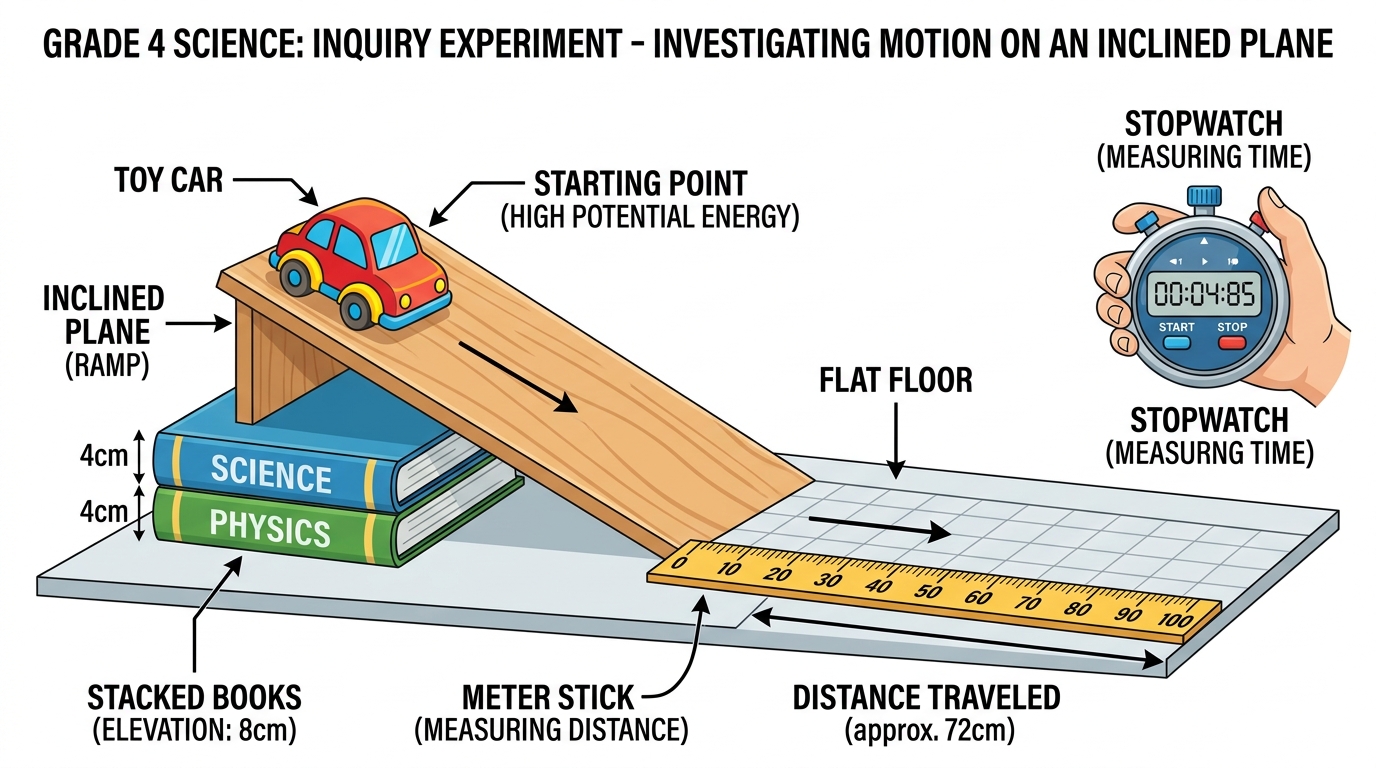
Grade 4 students investigated how ramp height affects a toy car's travel distance and time. They raised the ramp using books (4 cm, 8 cm, 12 cm) and measured how far the car rolled across the smooth floor.
Part E
Analyze the Experimental Data: Review the table and answer the scientific inquiry questions.
| Ramp Elevation |
Distance Traveled on Floor |
Time to Stop |
Average Speed Trend |
| 1 Book (4 cm high) |
45 centimeters |
3.0 seconds |
Slow motion (15 cm/s) |
| 2 Books (8 cm high) |
72 centimeters |
2.4 seconds |
Moderate motion (30 cm/s) |
| 3 Books (12 cm high) |
105 centimeters |
2.1 seconds |
Fast motion (50 cm/s) |
1. What is the independent variable (the one condition the students intentionally changed in this test)?
2. How did increasing the ramp elevation affect the distance the toy car traveled?
3. What two factors must be kept the same (controlled variables) to make this experiment a fair test?
4. STEM Safety Challenge: A crosswalk is 10 meters wide. A student walks at 1 m/s. How many seconds will it take to cross safely? If a car is 40 meters away moving at 10 m/s, is it safe to cross?