
Kiddie Blocks PH
Tutorial Center & Learning Hub

Animal Classification by Food Eaten

Quarter 2: Living Things & Their Environment
Grade 4 Science
Concept Reviewer
Learner:
Grade & Section:
Date:
Score:
DepEd MATATAG Aligned Classify animals into herbivores, carnivores, and omnivores; infer feeding habits and adaptations from body and teeth structures.
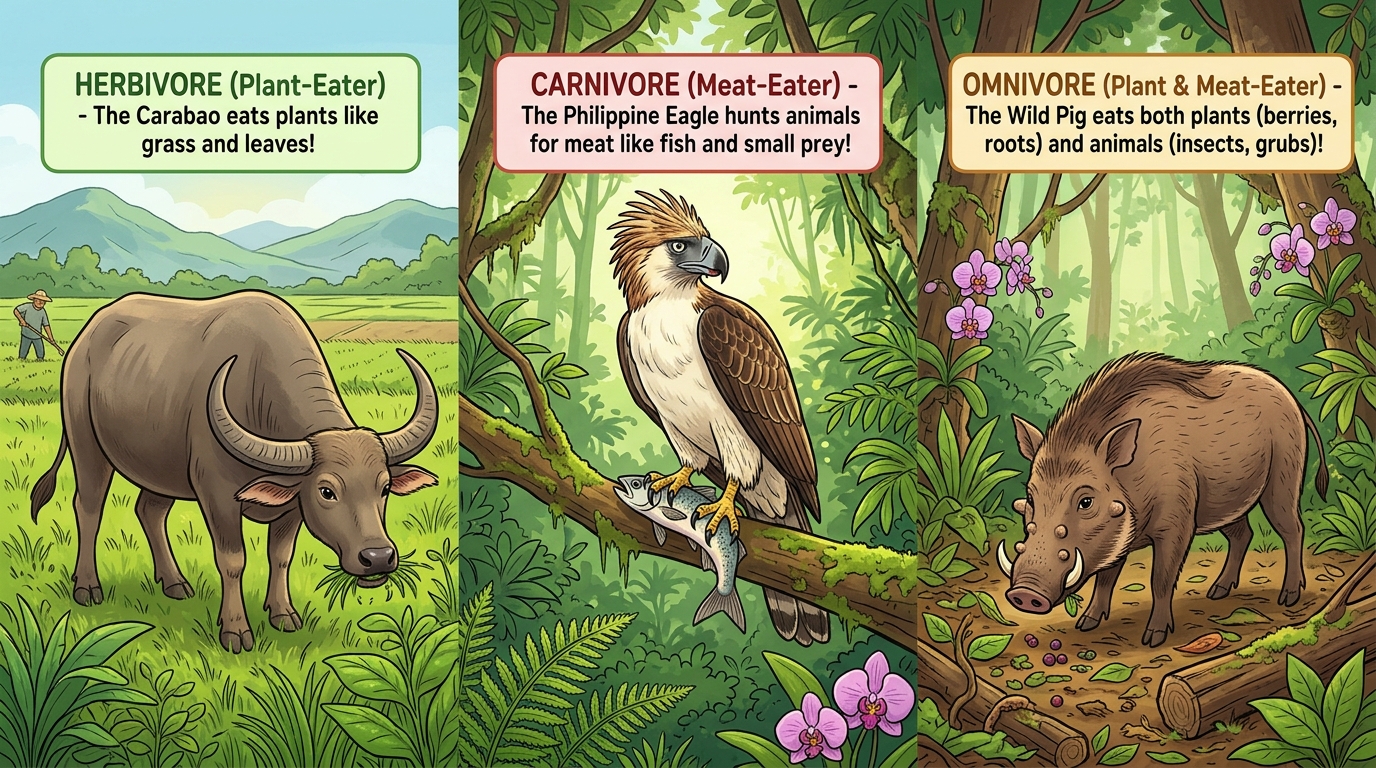
Philippine Carabao, Philippine Eagle, and Wild Pig showing Herbivore, Carnivore, and Omnivore diets
Classifying Animals by Diet: Animals need food for energy, growth, and survival. Because animals cannot produce their own food like green plants do, they must feed on other living organisms. Scientists classify animals into three primary dietary groups: Herbivores (plant-eaters), Carnivores (meat-eaters), and Omnivores (both plant and meat-eaters).
Core Review Review the 3 dietary classifications, their adaptations, and Philippine wildlife examples:
1. Herbivores Plant-Eaters

Diet: Grass, leaves, fruits, bark, nectar, roots, and seeds.
Key Adaptations: Sharp incisors to cut grass; broad, flat molars for grinding tough plant fibers.
Examples: Carabao, cow, goat, caterpillar, grasshopper, fruit bat, Philippine deer (usa).

2. Carnivores Meat-Eaters

Diet: Meat and flesh of other animals (prey).
Key Adaptations: Long, pointed canine teeth (fangs) to tear flesh; curved talons and hooked beaks in birds of prey.
Examples: Philippine eagle, tiger, lion, king cobra, monitor lizard (bayawak), shark.

3. Omnivores Both Eaters

Diet: Both plant matter (vegetables, grains, fruits) and animal meat.
Key Adaptations: A combination of sharp front incisors/canines and broad, flat grinding molars.
Examples: Humans, domestic pigs, chickens, brown bears, tilapia, Philippine warty pig.
🌿 Primary Consumers: Herbivores eat producers (green plants), transferring solar energy to the animal kingdom.
🥩 Secondary & Tertiary: Carnivores hunt herbivores and smaller carnivores, preventing overpopulation in habitats.
🍲 Flexible Consumers: Omnivores adapt to seasons, eating fruits, grains, insects, or meat depending on availability.
💡 Science Memory Clue: Look at the Latin roots! Herba = green plant; Carni = flesh or meat; Omni = all or everything; Vore = to eat or devour. An animal's mouthparts and teeth are perfectly matched to what it eats!
Kiddie Blocks PH
Tutorial Center & Learning Hub

Worksheet 4.1: Animal Diet Classification

Identifying & Sorting Animals by Feeding Habits
Grade 4 Science
Page 2 of 5
Learner:
Grade & Section:
Date:
Score:
Part A Sorting Bank: Classify each animal into the correct column based on what it eats in nature:
Carabao (Kalabaw) Philippine Eagle Native Chicken Fruit Bat (Paniki) Monitor Lizard (Bayawak) Domestic Cat Tilapia Fish Caterpillar Wild Pig (Baboy Ramo)
🌿 Herbivores (Plant-Eaters)
1.
2.
3.
🥩 Carnivores (Meat-Eaters)
1.
2.
3.
🍲 Omnivores (Both Eaters)
1.
2.
3.
Part B Feeding Adaptation Detective: Read each clue and identify the animal group and body part:

1. An animal possesses wide, flat, ridged back teeth. What are these teeth called, and what specific food do they help grind?

2. A predator in the forest has long, sharp, curved canine teeth and sharp claws. What type of food does it hunt, and how do canines help?

3. A backyard chicken pecks at scattered corn grains, leaves, and worms in the soil. Is the chicken a herbivore, carnivore, or omnivore? Explain briefly.

Part C Science Fact or Myth: Write FACT if the statement is true, or MYTH if it is false:

1. [           ] All birds are herbivores because they have beaks and do not possess sharp teeth.

2. [           ] A lion fed only with cooked vegetables and rice cannot survive healthily because its digestive system and teeth are built for meat.

Kiddie Blocks PH
Tutorial Center & Learning Hub

Worksheet 4.2: Feeding Niches & Food Chains

Ecosystem Balance in Philippine Habitats
Grade 4 Science
Page 3 of 5
Learner:
Grade & Section:
Date:
Score:
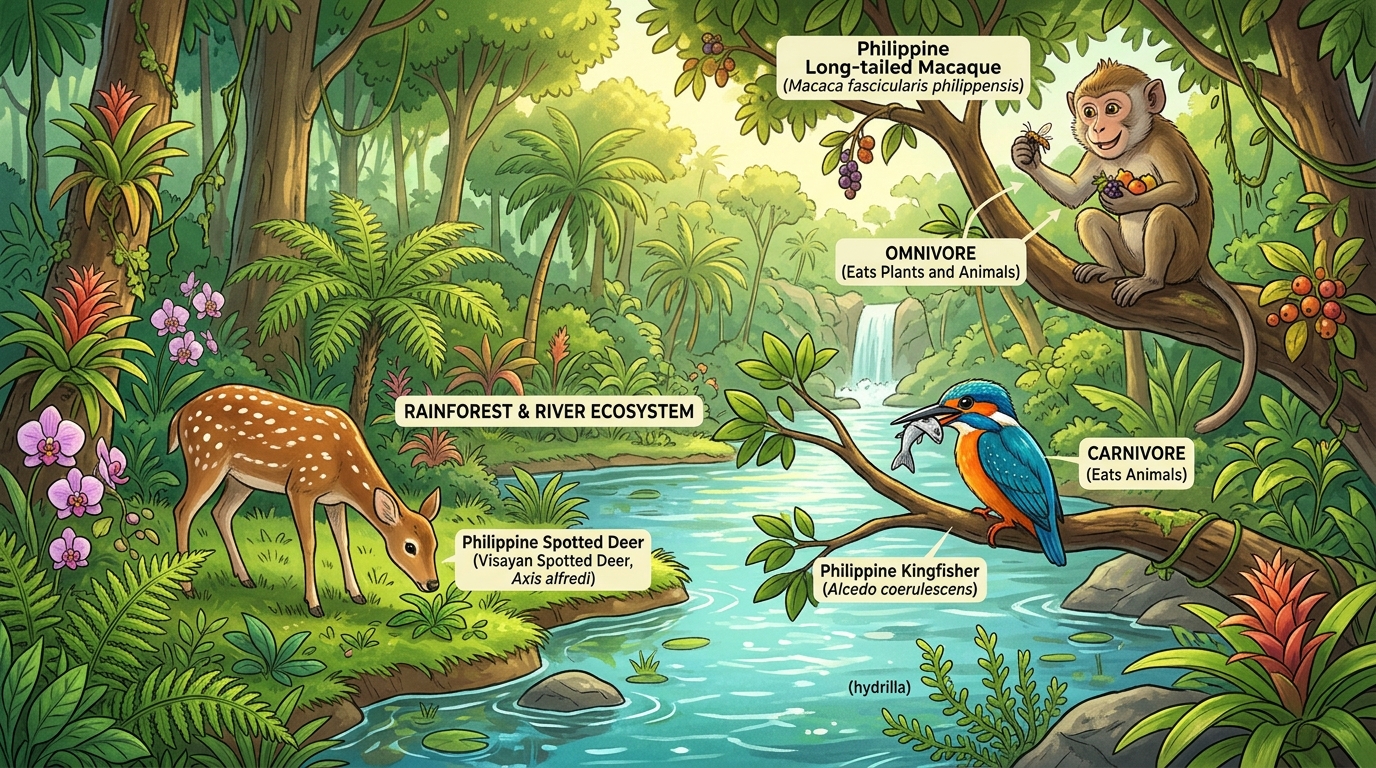
Philippine spotted deer, kingfisher bird, and macaque monkey in tropical rainforest ecosystem
Philippine Wildlife Feeding Niches: In a Philippine tropical rainforest, organisms interact closely through their diets. Green plants are the producers. Herbivores (like the spotted deer) consume plants. Carnivores (like the kingfisher) hunt small animals. Omnivores (like the macaque) forage for fruits and insects, keeping the ecosystem balanced.
Part A Food Chain Construction: Arrange the four organisms into a proper food chain showing energy flow:
Producer Palay / Rice Plant
➔
Herbivore (Primary) Grasshopper
➔
Carnivore (Secondary) Field Frog
➔
Carnivore (Apex) Philippine Hawk
Part B Multiple Choice: Shade the circle of the correct answer:

1. Which animal in the food chain above functions as the primary consumer that gets energy by eating plants?

A Palay / Rice Plant
B Grasshopper
C Field Frog
D Philippine Hawk

2. Why are herbivores considered essential links between plants and carnivores in every food chain?

A They hunt predators at night.
B They convert plant energy into animal flesh for meat-eaters.
C They eat both dead plants and decaying meat.
D They produce seeds directly from sunlight.
Part C Ecosystem Scenario: Read carefully and write your explanation on the line provided:

1. In a coral reef, Parrotfish eat algae (herbivore) while Groupers (lapu-lapu) eat small fish (carnivore). If all parrotfish disappear, what will happen to the algae covering the corals?

Kiddie Blocks PH
Tutorial Center & Learning Hub

Worksheet 4.3: Dental Adaptations & Inquiry

Scientific Analysis of Animal Teeth & Biodiversity
Grade 4 Science
Page 4 of 5
Learner:
Grade & Section:
Date:
Score:
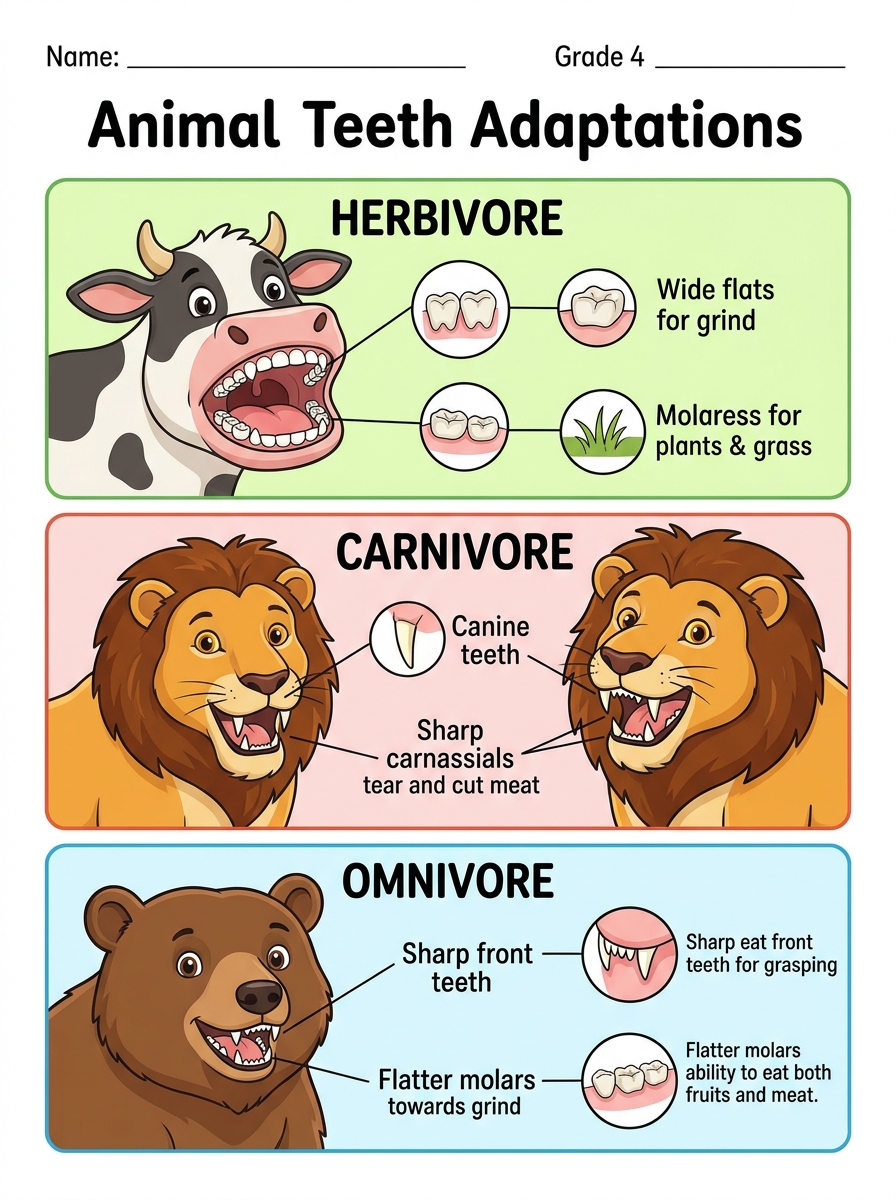
Educational diagram comparing teeth adaptations of herbivores, carnivores, and omnivores
Dentition Reflects Diet: An animal's teeth provide unmistakable scientific clues about what it eats: Herbivores: Flat, ridged molars for grinding tough cellulose plants.
Carnivores: Long, pointed canine fangs for seizing and tearing prey.
Omnivores: Complete mix of incisors (cutting), canines (tearing), and molars (grinding).
Part A Dental Detective: Analyze the 3 mystery skull descriptions below. Classify each specimen's diet:

Specimen X: Prominent curved sharp fangs at the corners of the jaw and blade-like cheek teeth. No flat molars.

Classification: [                                 ]   Likely Food: [                                 ]

Specimen Y: Sharp front incisors for cutting food, alongside flat broad back molars for chewing both meats and greens.

Classification: [                                 ]   Example Organism: [                                 ]

Specimen Z: Wide jaw dominated by large, flat, corrugated grinding molars with no pointed canine fangs.

Classification: [                                 ]   Likely Food: [                                 ]

Part B Philippine Endemic Species: Classify each protected Philippine animal by diet:

1. Tamaraw (Mindoro Dwarf Buffalo): Feeds exclusively on wild cogon grasses and bamboo shoots. Classification: [                                             ]

2. Philippine Crocodile: Feeds on freshwater fish, snails, frogs, and water birds. Classification: [                                             ]

Part C Higher-Order Thinking Question (HOTS): Answer in 1 to 2 clear sentences:

★ Why are humans classified as omnivores? Give evidence based on our teeth and our daily food.

Educator & Parent Answer Key & Diagnostic Guide

Grade 4 Science • Quarter 2: Classifying Animals According to Food Eaten
Teacher Edition
Worksheet 4.1 Solutions
Part A: Sorting Bank
• Herbivores: Carabao, Fruit Bat, Caterpillar
• Carnivores: Philippine Eagle, Monitor Lizard (Bayawak), Domestic Cat
• Omnivores: Native Chicken, Tilapia Fish, Wild Pig (Baboy Ramo)
Part B: Feeding Adaptation Detective
1. Molars: Flat, ridged chewing teeth; specialized to grind tough plant fibers, cellulose, and grass.
2. Meat / Animal prey: Canines are long and pointed to grip living prey, puncture hide, and tear tough meat.
3. Omnivore: Chickens eat seeds/grains (plant) and earthworms/insects (meat/animal protein).
Part C: Fact or Myth
1. MYTH (Many birds like eagles and owls are fierce carnivores eating mice and fish).
2. FACT (Carnivores have short intestines and sharp dentition designed exclusively for meat digestion).
Worksheet 4.2 & 4.3 Solutions
Worksheet 4.2 Solutions
• Part A (Food Chain): Palay (Producer) ➔ Grasshopper (Herbivore) ➔ Frog (Carnivore) ➔ Hawk (Apex Carnivore).
• Part B (Multiple Choice): 1: B (Grasshopper) | 2: B (Convert plant energy) | 3: C (Frogs will starve and decline)
• Part C (Scenario): Without parrotfish grazing on algae, algae will overgrow and smother the living corals, blocking sunlight and destroying the reef habitat.
Worksheet 4.3 Solutions
• Specimen X: Carnivore (Food: Meat/Prey flesh; teeth: pointed fangs & carnassials).
• Specimen Y: Omnivore (Example: Human, Pig, or Bear; teeth: front incisors & flat molars).
• Specimen Z: Herbivore (Food: Grass, leaves; teeth: large grinding molars).
• Part B (Philippine Wildlife): 1. Tamaraw: Herbivore | 2. Philippine Crocodile: Carnivore | 3. Musang: Omnivore.
• Part C (HOTS): Humans have both sharp front teeth (incisors/canines) for biting and flat back molars for chewing, allowing us to digest both plant foods and meats.
Teacher Diagnostic Guide & Common Student Misconceptions
Common Misconception Scientific Clarification Recommended Remediation Strategy
"All birds are herbivores because they lack teeth." Birds have specialized beaks adapted to their diet. Raptors (Philippine eagle, hawk) have hooked, sharp beaks for ripping flesh (carnivores), while herons have spear-like beaks for fish. Compare beaks of different birds: eagle (carnivore), parrot (herbivore/frugivore), and crow (omnivore).
"Insect-eaters (insectivores) are herbivores because bugs are small." Insects are animals made of flesh and protein. Any animal that eats insects (frogs, lizards, dragonflies, bats) is eating animal flesh and is therefore a carnivore. Have students categorize food into "Plant Kingdom" vs "Animal Kingdom" before classifying the consumer.
"Omnivores must eat half plants and half meat at every meal." Omnivory means the biological capability to survive on nutrients from both plant and animal sources across seasons, not equal proportions daily. Examine human and bear seasonal diets: fruits/berries in summer, fish/meat when available.
Performance Level Rubric: Mastery (90-100%): Accurately classifies all animals and explains teeth adaptations with zero errors. Developing (75-89%): Classifies common animals correctly; minor confusion with insectivores or omnivores. Beginning (<75%): Needs tactile review comparing human teeth in a mirror and matching flashcards.