Kiddie Blocks PH
Tutorial Center • Project 8, Quezon City

Grade 4 English: Comprehensive Reviewer

Author's Purpose (PIEE) • Reality vs. Make-Believe • Fiction & Non-Fiction
Grade 4 • English
Page 1 of 6 (Reviewer)
Student Name:
Date:
Section:
🎯 MATATAG Curriculum Focus: Determining Author's Intent, Evaluating Reality vs. Fantasy, and Analyzing Literary Genres
EN4RC-III-1 • EN4LR-III-2 • EN4VR-III-3
1. Understanding Author's Purpose: The PIEE Framework Why Did the Author Write This?
Every author writes with a specific goal in mind. In Grade 4, remember the acronym P - I - E - E:
📢 P – PERSUADE
Goal: Convince the reader to believe, think, feel, or do something.
Clues: Should, must, best, don't miss out, buy now, opinion words.
Examples: Commercials, campaign flyers, opinion articles, debate speeches.
📚 I – INFORM
Goal: Give factual, true, and objective information about a topic.
Clues: Dates, numbers, statistics, historical facts, scientific records.
Examples: News articles, textbooks, encyclopedias, documentary summaries.
⚙️ E – EXPLAIN
Goal: Teach how something works or why a process happens step-by-step.
Clues: First, next, then, because, as a result, how-to instructions.
Examples: Science experiments, cookbooks, user manuals, weather guides.
🎭 E – ENTERTAIN
Goal: Amuse, excite, evoke emotions, or make the reader laugh or dream.
Clues: Characters, dialogue, humor, plot twists, magical twists, rhymes.
Examples: Fairy tales, poems, fables, comic books, adventure stories.
2. Reality vs. Make-Believe & Fiction vs. Non-Fiction Critical Thinking
  • Reality (Katotohanan): Events and facts that can truly happen in real life. They follow the laws of science and nature (e.g., Dogs bark and birds lay eggs).
  • Make-Believe / Fantasy (Katha): Imaginative elements that cannot happen in real life. They involve magic, impossible feats, or talking animals (e.g., A fox wearing a bag cast a spell with a wand).
  • Fiction (Likhang-isip): Stories created from the writer's imagination. Includes realistic fiction (could happen, but invented) and fantasy (impossible magic).
  • Non-Fiction (Di-Katha): Writing based strictly on true facts, real historical figures, and real events (biographies, scientific journals).
Visual Anchor Concept Comparison
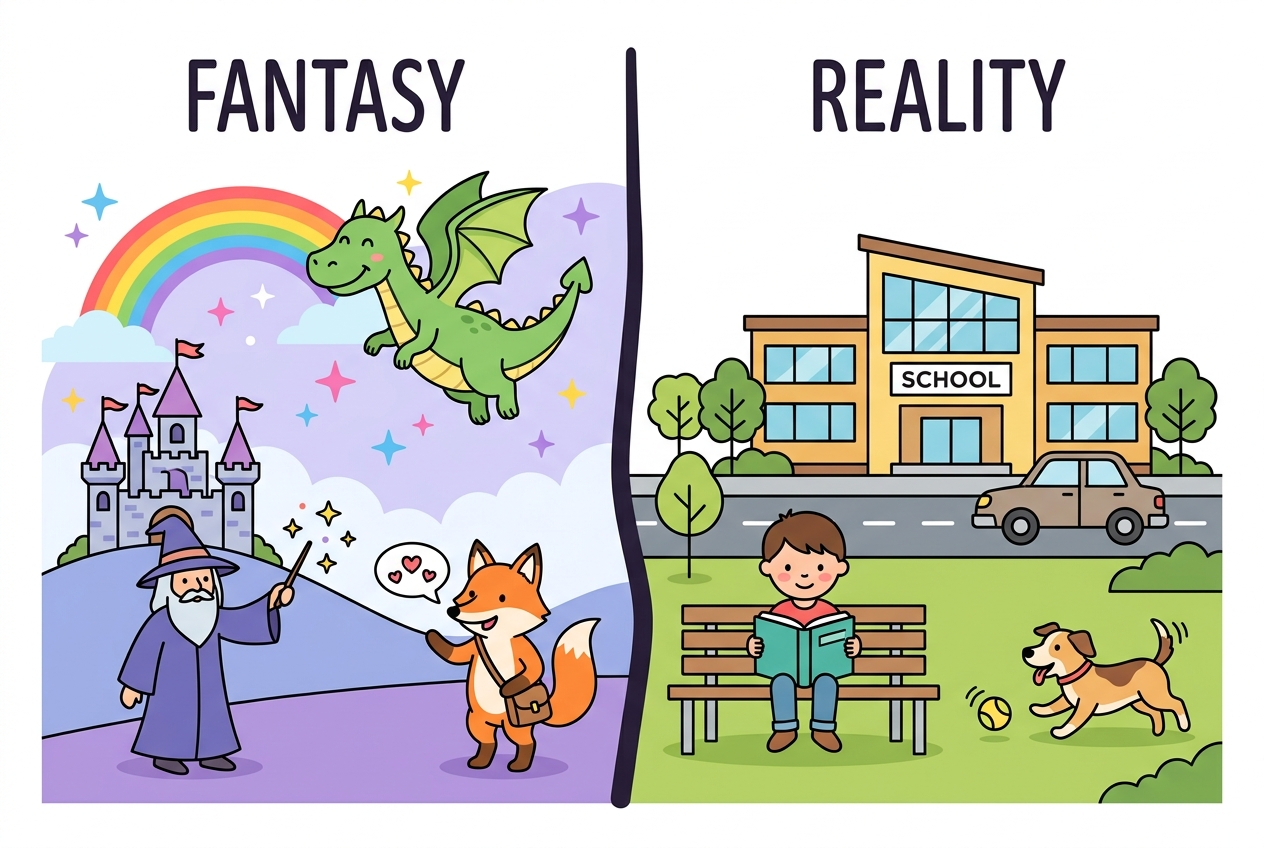
Fantasy vs Reality Illustration
Left: Fantasy (Dragon & Wizard) | Right: Reality (Boy Reading & Puppy)
3. Quick Detective Checklist: Distinguishing Text Features Fast Recognition
Question to Ask If YES, it points to... Key Clues to Circle
Is the writer asking you to buy, join, or change your opinion? PERSUADE Best, should, must, adopt now, our guarantee
Does it share real numbers, historical years, or true facts? INFORM • NON-FICTION Dates, verified statistics, scientific descriptions
Does it break down the steps of a process or how it functions? EXPLAIN Step 1-2-3, because, as a result, recipe directions
Can animals talk, fly on brooms, or cast magic spells? MAKE-BELIEVE • FICTION Wizards, dragons, potions, talking wildlife
BOOST YOUR CHILD'S LEARNING NOW! BOOK AN INITIAL SESSION TODAY!
📍 Tandang Sora Ave., Project 8, Quezon City | 📞 09540351970 | 🌐 kiddieblocks.com | facebook.com/kiddieblocksph
Kiddie Blocks PH
Tutorial Center • Project 8, Quezon City

Worksheet 1: Identifying the Author's Purpose

Persuade, Inform, Explain, or Entertain (PIEE) Mastery
Grade 4 • English
Page 2 of 6
Student Name:
Date:
Score: / 20
Part A: Quick PIEE Classifier (8 Points)
Write P, I, E, or Ent
Read each short snippet. Write P for Persuade, I for Inform, E for Explain, or Ent for Entertain on the blank line before each number.
1.
[ ] “Mount Mayon in Albay has an elevation of 2,463 meters and is renowned worldwide for its near-perfect symmetrical cone shape.”
2.
[ ] “Don't throw plastic bottles in the drainage canals! Protect our barangay from devastating floods by joining our clean-up drive this Saturday!”
3.
[ ] “To make sunny-side-up eggs, first heat one tablespoon of oil in a skillet. Next, gently crack the egg into the pan and cook on low heat for three minutes.”
4.
[ ] “The mischievous monkey slipped on a banana peel, somersaulted over a sleeping carabao, and landed straight into a basket of ripe mangoes!”
5.
[ ] “Photosynthesis occurs because chlorophyll in green leaves absorbs sunlight and transforms water and carbon dioxide into glucose and oxygen.”
6.
[ ] “Visit the new Kiddie Blocks learning studio in Project 8! Our personalized tutors provide the finest exam preparation in Quezon City. Book today!”
7.
[ ] “The Philippine eagle has a wingspan of over two meters and feeds primarily on flying lemurs, snakes, and monkeys in old-growth rainforests.”
8.
[ ] “Once upon a moonlit night, Princess Tala made a wish upon a fallen star, and her wooden doll suddenly began to tap dance!”
Part B: Deep In-Context Analysis & Author's Clues (8 Points)
Identifying Purpose & Evidence
Read the two paragraphs below. Identify the author's primary purpose and write down the key clue words that prove it.
Passage A: “Healthy breakfast habits are essential for young elementary learners. Skipping breakfast leads to sluggish concentration and poor memory during morning math drills. You should always start your day with a wholesome meal of eggs, fruit, and warm milk. Invest in your brain power every morning; make breakfast an unbreakable daily habit!”
9.
Author's Primary Purpose:
10.
Key Clue Words:
Passage B: “Why do we hear thunder after seeing lightning? Lightning and thunder happen at the exact same moment. However, light travels at an incredible speed of 300,000 kilometers per second, while sound travels through air at only about 340 meters per second. Because light moves almost a million times faster than sound, your eyes see the flash instantly, while the sound waves take several seconds to reach your ears.”
11.
Author's Primary Purpose:
12.
Key Reason:
Part C: Multiple Choice Scenario Master (4 Points)
Evaluating Author's Intent
Circle the letter of the correct answer for each scenario.
13.
A poster on the school hallway shows a sad dog with the slogan: “Be a hero! Adopt a rescued pet from the city pound today instead of buying from puppy mills.” The author's main purpose is to:
A. Entertain      B. Persuade      C. Explain how a dog runs
14.
A science book chapter details the life cycle of a frog from egg to tadpole to adult with diagrams and timestamps. The author's primary purpose is to:
A. Explain & Inform      B. Persuade people to eat frogs      C. Entertain with funny jokes
BOOST YOUR CHILD'S LEARNING NOW! BOOK AN INITIAL SESSION TODAY!
📍 Tandang Sora Ave., Project 8, Quezon City | 📞 09540351970 | 🌐 kiddieblocks.com | facebook.com/kiddieblocksph
Kiddie Blocks PH
Tutorial Center • Project 8, Quezon City

Worksheet 2: Reality vs. Make-Believe & Fiction

Critical Thinking • Fact vs. Fantasy • Fiction vs. Non-Fiction
Grade 4 • English
Page 3 of 6
Student Name:
Date:
Score: / 20
Part A: Reality vs. Make-Believe Sentence Detective (8 Points)
Could this truly happen?
Read each statement. Write REALITY if it can happen in real life. Write MAKE-BELIEVE if it is impossible, magical, or purely imaginary.
1.
[ ] A loyal golden retriever barked loudly to alert the family when smoke entered the kitchen.
2.
[ ] The wise brown owl put on tiny spectacles and taught an algebra lesson to the squirrels.
3.
[ ] After touching the enchanted silver pebble, Paolo sprouted shimmering wings and flew to the clouds.
4.
[ ] Filipino farmers in Nueva Ecija plant rice seedlings during the rainy monsoon season.
5.
[ ] A red sports car drove along the North Luzon Expressway at eighty kilometers per hour.
6.
[ ] The friendly green dragon blew warm fire to toast marshmallows for the village children.
7.
[ ] Mang Berto watered his tomato garden every morning to help the plants produce juicy fruit.
8.
[ ] The moon whispered a secret lullaby to the waves as they danced upon the seashore.
Part B: The School Library Shelf — Fiction vs. Non-Fiction (6 Points)
Sorting Book Types
Read the description of each book on the library shelf. Write FICTION or NON-FICTION on the line provided.
9.
“Dr. Jose Rizal: The Patriot Hero of Calamba” — A factual biography describing the real life, medical studies, and novels of Dr. Rizal based on historical letters.
Classification:
10.
“The Dragon Who Loved Tablea Tsokolate” — An imaginative tale about a friendly dragon living in Mount Arayat who bakes hot cocoa for travelers.
Classification:
11.
“Philippine Coral Reefs & Marine Life” — A full-color science guide showcasing actual underwater photographs, fish species, and ocean conservation data.
Classification:
12.
“Aling Rosa's Magic Broom” — A story about an old broom that sweeps by itself and flies across the rooftops at midnight.
Classification:
13.
“The Atlas of the 17 Regions of the Philippines” — An official reference volume containing provincial maps, population censuses, and local capitals.
Classification:
14.
“The Legend of the Pineapple (Alamat ng Pinya)” — A traditional folktale explaining how a spoiled girl named Pina was transformed into a fruit with a hundred eyes.
Classification:
Part C: The Imagination Transformer — Make-Believe to Reality (6 Points)
Rewrite into Real Life
Read the make-believe sentence. Then, rewrite it into a realistic sentence that could actually happen in real life.
15.
Make-Believe: “When Andrea lost her pencil, a magic fairy tapped her desk with a glitter wand and created a box of twenty golden pencils.”
Your Realistic Version:
16.
Make-Believe: “The brown puppy opened his mouth and spoke fluent English to tell the doctor where his paw hurt.”
Your Realistic Version:
BOOST YOUR CHILD'S LEARNING NOW! BOOK AN INITIAL SESSION TODAY!
📍 Tandang Sora Ave., Project 8, Quezon City | 📞 09540351970 | 🌐 kiddieblocks.com | facebook.com/kiddieblocksph
Kiddie Blocks PH
Tutorial Center • Project 8, Quezon City

Worksheet 3: Integrated Reading Passages

Author's Purpose, Reality/Fantasy, and Fiction/Non-Fiction in Action
Grade 4 • English
Page 4 of 6
Student Name:
Date:
Score: / 20
Text 1: Eco-Friendly Bamboo Straws Eco Campaign
Say NO to single-use plastic! Millions of plastic straws pollute our beautiful Philippine oceans every year, endangering sea turtles and corals. Switch today to our all-natural, biodegradable Bamboo Sip Straws. They are washable, durable, and stylish. Protect our marine treasures; purchase your pack now and be a certified ocean guardian!
1. Author's Purpose:
2. Reality or Make-Believe?
3. Genre: (Fiction / Non-Fiction): ______________
Text 2: How Clouds Form in the Sky Earth Science
Clouds form through a three-stage natural process. First, solar heat evaporates water from oceans, rivers, and soil into invisible water vapor. Next, as the warm vapor rises high into the cooler atmosphere, it condenses around tiny airborne dust particles. Finally, trillions of these microscopic water droplets cluster together to form visible white clouds.
4. Author's Purpose:
5. Reality or Make-Believe?
6. Signal Words used: ____________________________
Text 3: The Tubbataha Reefs National Park Conservation Fact
Located in the Sulu Sea near Palawan, the Tubbataha Reefs Natural Park covers 97,030 hectares of pristine marine ecosystem. Declared a UNESCO World Heritage Site in 1993, it shelters more than 600 fish species, 360 coral species, and 11 shark species, making it one of the richest biodiversity hotspots on Earth.
7. Author's Purpose:
8. Reality or Make-Believe?
9. Genre: (Fiction / Non-Fiction): ______________
Text 4: The Cloud Dragon of Mount Isarog Folk Fantasy
High above the emerald slopes of Mount Isarog slept Bakunawa, a gentle dragon made entirely of fluffy mist. Whenever the forest creatures needed rain, Bakunawa sneezed three times, releasing sparkling silver raindrops. If a naughty imp tried to steal the mountain crystals, the dragon roared a song of thunder that tickled the imp's ears!
10. Author's Purpose:
11. Reality or Make-Believe?
12. Genre: (Fiction / Non-Fiction): _____________
Part B: Comparative Critical Thinking (8 Points)
Synthesizing Text Types
13.
How does the author of Text 1 try to convince the reader to act?
A. By telling a funny joke about dragons      B. By warning about plastic pollution in oceans and urging to "purchase now"
14.
Compare Text 2 and Text 3. Both deal with real science and geography, but how does their primary purpose differ?
15.
In Text 4, identify two specific details that prove the passage is Make-Believe:
Detail 1:     Detail 2:
16.
If you wanted to write a report for your Science teacher about endangered Philippine animals, which text style would you choose? (Persuade / Inform / Explain / Entertain):
BOOST YOUR CHILD'S LEARNING NOW! BOOK AN INITIAL SESSION TODAY!
📍 Tandang Sora Ave., Project 8, Quezon City | 📞 09540351970 | 🌐 kiddieblocks.com | facebook.com/kiddieblocksph
Kiddie Blocks PH
Tutorial Center • Project 8, Quezon City

Worksheet 4: Short Story Comprehension

“The Secret of the Firefly Grove” • Literary & Critical Reading
Grade 4 • English
Page 5 of 6
Student Name:
Date:
Score: / 20
✨ The Secret of the Firefly Grove

Ten-year-old Lucas loved reading fantasy fairy tales before bedtime. His favorite story told of the “Diwata of the Night,” a magical forest spirit who sprinkled golden star-dust across the trees to light the path for lost wanderers. One warm April evening while visiting his grandparents' farm in Project 8, Lucas saw thousands of tiny pulsating lights shimmering near the damp bamboo grove.

“Look, Lolo!” Lucas gasped in awe, clutching his wooden walking stick. “The diwata's fairy army has arrived with their miniature lanterns! If we tiptoe closer, maybe they will grant us three wishes!” Lucas was convinced he was witnessing true make-believe magic.

Lolo Ramon smiled warmly and placed a gentle hand on his grandson's shoulder. He retrieved a small glass magnifying jar and a pocket flashlight. “Come quietly, Lucas, and let us observe closely,” Lolo whispered. Gently catching one glowing speck against a bamboo leaf, Lolo handed the jar to Lucas. Through the glass, Lucas saw not a winged fairy, but a small, brown-winged beetle with a soft, yellowish abdomen.

“These are fireflies, or alitaptap,” Lolo Ramon explained. “They do not possess magical spells, but their real science is even more extraordinary! In their lower bodies, a chemical called luciferin mixes with oxygen and special enzymes to create 100% cold light without wasting any heat. They flash their bioluminescent lights in steady rhythms to communicate with one another and find mates in the dark.”

Lucas gazed up at the twinkling canopy with renewed wonder. He realized that while fantasy stories were thrilling to imagine, the scientific reality of the natural world was equally breathtaking. “Nature has its own true magic, Lolo,” Lucas smiled, carefully setting the firefly free into the warm night breeze.

Comprehension & Critical Thinking Questions (20 Points)
Literal, Inferential & Structural
1.
What did Lucas initially believe was creating the glowing lights in the bamboo grove?
2.
What real creature was actually producing the glowing lights?
3.
Identify one MAKE-BELIEVE thought that Lucas had during the story:
4.
What REALITY did Lolo Ramon reveal when examining the beetle under the magnifying jar?
5.
What was the author's primary purpose in writing this story?
A. To entertain the reader with an engaging story while informing them about the science of fireflies.
B. To persuade readers to buy glass jars and flashlights.
C. To explain how to construct a bamboo house in the farm.
6.
This story is classified as Realistic Fiction. Why is it considered fiction (not non-fiction), even though the science of fireflies is completely real?
7.
At the end of the story, Lucas concludes that “nature has its own true magic.” What did he mean by this statement?
BOOST YOUR CHILD'S LEARNING NOW! BOOK AN INITIAL SESSION TODAY!
📍 Tandang Sora Ave., Project 8, Quezon City | 📞 09540351970 | 🌐 kiddieblocks.com | facebook.com/kiddieblocksph
Kiddie Blocks PH
Tutorial Center • Project 8, Quezon City

Complete Answer Key & Pedagogical Guide

For Parents, Tutors, and Teachers • Quick Scoring
Answer Key
Page 6 of 6
Evaluator:
Grading Date:
Total Score: / 80
Worksheet 1: Author's Purpose (PIEE) 20 Points
Part A (1-8 Classifier):
1. I (Inform) [Factual elevation and geographical description]
2. P (Persuade) [Call to action, "Don't throw", "Join us"]
3. E (Explain) [Step-by-step cooking process: First, Next]
4. Ent (Entertain) [Humorous story of a monkey slipping on a peel]
5. E (Explain) [Scientific explanation of how photosynthesis works]
6. P (Persuade) [Ad campaign: "Finest exam prep", "Book today"]
7. I (Inform) [Factual wingspan and diet of Philippine eagle]
8. Ent (Entertain) [Fairy tale: wishing on star, tap-dancing doll]
Part B (9-12 Passage Analysis):
9. Persuade | 10. Clues: "essential", "You should always", "Invest in your brain", "make breakfast an unbreakable habit".
11. Explain | 12. Reason: Explains why thunder is heard after lightning by comparing the speed of light vs. speed of sound.
Part C (13-14 Multiple Choice):
13. B (Persuade) | 14. A (Explain & Inform)
Worksheet 2: Reality vs. Make-Believe 20 Points
Part A (1-8 Sentence Detective):
1. REALITY (Dogs can bark to warn of fire/smoke)
2. MAKE-BELIEVE (Owls cannot wear glasses or teach algebra)
3. MAKE-BELIEVE (Humans cannot sprout wings from pebbles)
4. REALITY (Farmers plant seedlings in monsoon season)
5. REALITY (Cars driving on highway is normal reality)
6. MAKE-BELIEVE (Dragons are mythical; cannot toast marshmallows)
7. REALITY (Watering plants is real agricultural practice)
8. MAKE-BELIEVE (The moon cannot whisper or waves dance)
Part B (9-14 Library Shelf):
9. NON-FICTION (Rizal factual biography)
10. FICTION (Imaginative dragon story)
11. NON-FICTION (Real coral reef science guide)
12. FICTION (Flying magical broom story)
13. NON-FICTION (Geographical atlas with census data)
14. FICTION (Traditional folktale/legend)
Part C (15-16 Transformer):
15. Sample: When Andrea lost her pencil, her classmate shared an extra yellow pencil from his pencil case.
16. Sample: The puppy whined softly and limped to show the veterinarian where his paw was injured.
Worksheet 3: Integrated Passages 20 Points
Text 1 (Bamboo Straws):
1. Persuade | 2. Reality | 3. Non-Fiction
Text 2 (Cloud Formation):
4. Explain | 5. Reality | 6. First, Next, Finally
Text 3 (Tubbataha Reefs):
7. Inform | 8. Reality | 9. Non-Fiction
Text 4 (Cloud Dragon):
10. Entertain | 11. Make-Believe | 12. Fiction
Part B (13-16 Comparative Questions):
13. B (Urging ocean protection and to purchase now)
14. Text 2 explains a natural process (how clouds form), whereas Text 3 gives verified factual data/statistics about a national park.
15. Detail 1: A dragon made of mist; Detail 2: Sneezing raindrops / roaring thunder song to tickle imps.
16. Inform (and Explain).
Worksheet 4: Story Comprehension 20 Points
1. Lucas's Initial Belief: He thought the glowing lights were the diwata's fairy army with miniature lanterns that could grant wishes.
2. Real Creature: Fireflies (alitaptap) or small beetles.
3. Make-Believe Thought: Believing fairies were sprinkling star-dust or that they would grant three wishes.
4. Reality Revealed: A brown-winged beetle using a chemical reaction (luciferin, oxygen, and enzymes) to generate cold bioluminescent light.
5. Primary Purpose: A (To entertain with an engaging story while informing about the science of fireflies).
6. Why Realistic Fiction: The characters (Lucas and Lolo Ramon) and specific conversation are invented/fictional, even though the setting and firefly science are real.
7. Personal Reflection: Nature's real scientific processes (like bioluminescence) are just as wonderful, astonishing, and awe-inspiring as magical fairy tales.
Diagnostic Performance Rubric:
🌟 72 – 80 (Advanced / Mastery): Flawlessly identifies author's intent (PIEE), easily separates fantasy from reality, and articulates why a story is realistic fiction.
👍 60 – 71 (Proficient / Target): Good understanding of purpose; may occasionally confuse Inform with Explain on complex passages.
🌱 Below 60 (Developing / Review Needed): Needs guided coaching on spotting persuasion clues and distinguishing fantasy elements.
Target Competencies:
DepEd MATATAG ELA-4